
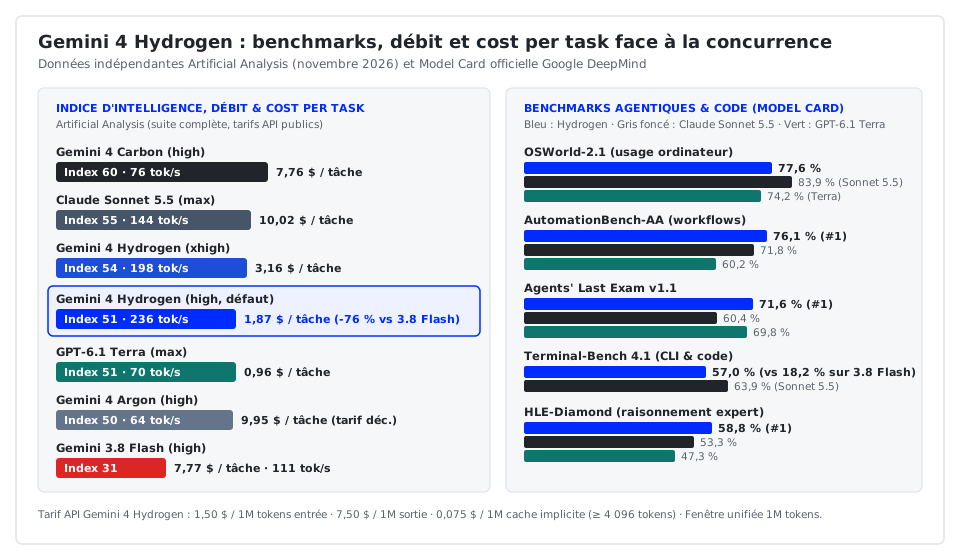
Officially released on November 12, 2026 by Google DeepMind, Gemini 4 Hydrogen (gemini-4-hydrogen) reshapes the cost-performance curve for production AI agents. While Gemini 4 Argon (October 2026) and Gemini 4 Carbon (November 10, 2026) target deep, long-horizon scientific and architectural reasoning, Hydrogen replaces Gemini 3.8 Flash as Google's high-velocity execution engine — yet performs like a frontier model. Scoring 51 on the Artificial Analysis Intelligence Index at its default setting (edging past Argon's 50) while streaming at 236 tokens per second, Hydrogen changes how engineering teams design multi-model pipelines.
Here is our full technical teardown: official DeepMind Model Card specifications, independent benchmark results, API pricing mechanics, real-world cost per task, and hands-on findings across data engineering and MCP agent workloads.
1. Architecture and core specifications of Gemini 4 Hydrogen
According to the official Google DeepMind Model Card, Gemini 4 Hydrogen is a closed-weights proprietary model adapted directly from Gemini 4 Carbon, the flagship model of the Gemini 4 family. Although parameter counts remain undisclosed, its serving specifications are purpose-built for iterative agent loops:
- Stable production model ID from day one:
gemini-4-hydrogen(live across the Gemini API, Google AI Studio — including a rate-limited free developer tier — Gemini Enterprise, Google Search, Google Sheets, and Google Antigravity). - Unified 1,048,576-token (1M) context window: input prompts, internal reasoning (thinking) tokens, and generated output share a single 1M-token pool at a flat rate.
- Output capacity: up to 65,536 tokens (64K) synchronously per call, and up to the full 1M context window via background long decode.
- Multimodal inputs: text, images, audio, video, complex multi-page PDFs, tables, and charts; structured text and tool-call outputs.
- Knowledge cutoff: March 2026.
The 4 thinking levels (thinking_level) and breaking API changes
Unlike Gemini 3.8 Flash, which defaulted to medium reasoning, Hydrogen defaults to high across four selectable settings inside generation_config: low, medium, high, and a new xhigh tier. Teams migrating existing production services from 3.8 Flash must account for three breaking API changes:
- Passing
minimalas a thinking level now throws a validation error. - Legacy sampling controls (
temperature,top_p, andtop_k) are ignored server-side to preserve reasoning stability. - Explicit context caching (
cached_content) is not supported; instead, Hydrogen relies on automatic implicit caching triggered on shared prompt prefixes of 4,096 tokens or more at a 95% input discount ($0.075/ 1M tokens).
2. Benchmark breakdown: where Hydrogen wins and where rivals hold the lead
Cross-referencing independent measurements from Artificial Analysis and Vals AI with Google DeepMind's evaluation suite against Claude Sonnet 5.5 and GPT-6.1 Terra reveals a clear capability profile:
| Benchmark / Metric | Gemini 4 Hydrogen | Gemini 3.8 Flash | Claude Sonnet 5.5 | GPT-6.1 Terra |
|---|---|---|---|---|
| Artificial Analysis Index | 51 (high) / 54 (xhigh) | 31 | 55 (max) | 51 (max) |
| Output speed | 236 tok/s (high) / 198 (xhigh) | 111 tok/s | 144 tok/s | 70 tok/s |
| Terminal-Bench 4.1 (CLI & code) | 57.0% | 18.2% | 63.9% | Not reported |
| SWE-sweep (repo maintenance) | 13.5% | — | 3.1% | 5.8% |
| AutomationBench-AA | 76.1% | — | 71.8% | 60.2% |
| Agents' Last Exam v1.1 | 71.6% | — | 60.4% | 69.8% |
| OSWorld-2.1 (computer use) | 77.6% | — | 83.9% | 74.2% |
| HLE-Diamond | 58.8% | — | 53.3% | 47.3% |
| Vals Tax Agent / Legal Research | 52.3% (#1) / 55.8% (tied #1) | — | — | — |
Key technical takeaways: the generational leap over Gemini 3.8 Flash is massive — a 20-point surge on the Intelligence Index and more than triple the score on Terminal-Bench 4.1 (57.0% vs. 18.2%). Hydrogen takes the #1 spot on enterprise workflow automation (AutomationBench-AA at 76.1%), visual chart understanding (Chartography at 66.6%), and Vals AI's tax and legal research benchmarks. Conversely, Claude Sonnet 5.5 retains a clear lead in complex terminal software engineering (63.9%) and GUI computer use (OSWorld-2.1 at 83.9%).
3. API pricing and the cost-per-task paradox: 2× per token, 76% cheaper per task
At first glance, Hydrogen's list price per token is twice Gemini 3.8 Flash's 2026 introductory rate:
- Input tokens: $1.50 / 1M tokens (flat across the entire 1M window).
- Output + thinking tokens: $7.50 / 1M tokens.
- Implicit cached input (≥ 4,096 tokens): $0.075 / 1M tokens (95% discount).
- Batch mode: $0.75 / 1M input and $3.75 / 1M output.
Importantly, Google's pricing schedule raises Gemini 3.8 Flash to $1.50 / $7.50 on January 1, 2027, while Gemini 4 Argon and Carbon increase from $2 / $10 to $4.00 / $20.00 on December 1, 2026.
Even today, as we detailed in our analysis of AI model cost per task, per-token pricing hides token efficiency and retry loops. Across the full Intelligence Index benchmark suite, Artificial Analysis recorded a real cost of $1.87 per index task for Gemini 4 Hydrogen (high), compared with $7.77 for Gemini 3.8 Flash and $9.95 for Gemini 4 Argon (at its December rate)!
Despite costing twice as much per raw token today, Hydrogen is four times cheaper to run in practice than 3.8 Flash because it uses 12% to 23% fewer tokens, succeeds on the first tool call far more often, and finishes tasks 2.5× faster. Watch out for the xhigh setting, however: Artificial Analysis notes significant reasoning verbosity that pushes task cost to $3.16 for a 3-point index gain (54 vs. 51). Meanwhile, GPT-6.1 Terra matches Hydrogen's 51 index score at roughly half the cost per task ($0.96), though at less than a third of Hydrogen's streaming speed (70 tok/s vs. 236 tok/s).
4. Hands-on evaluation on enterprise data and agent workloads
Testing gemini-4-hydrogen across three representative workloads from our AI engineering and Google Cloud practice highlights clear operational patterns:
- MCP tool-calling loops and analytical SQL (BigQuery / Snowflake): at
highthinking, end-to-end tool-loop latency feels remarkably snappy at ~236 tok/s. Even more valuable is agentic honesty: Google reports over 5× fewer fabricated claims than 3.8 Flash (96.7% on internal honesty evals) and 2.3× stronger indirect prompt-injection resilience. When a schema column is missing, Hydrogen asks for clarification or inspects metadata rather than hallucinating nonexistent SQL fields. - Long-context multimodal PDF and chart extraction: flat pricing up to 1M tokens paired with automatic $0.075/1M implicit caching makes multi-turn analysis over 300-page financial or engineering PDFs exceptionally economical from the second turn onward. One caveat documented in DeepMind's safety table (+5.57 percentage points in benign over-refusals) is noticeably stricter multimodal caution on borderline or low-resolution ID/compliance scans.
- Carbon + Hydrogen role-splitting (the Orchestrator pattern): mirroring Google Antigravity's Orchestrator mode — using Gemini 4 Carbon once to resolve ambiguity and write the execution plan, then handing iterative code edits, SQL checks, and test runs to Gemini 4 Hydrogen (
mediumorhigh) — delivers near-Carbon task completion while cutting quota and token spend by 24% to 60%.
Technical verdict: should you migrate to Gemini 4 Hydrogen?
Yes — immediately for any workload currently running on Gemini 3.8 Flash or Gemini 4 Argon. Hydrogen delivers Argon-beating intelligence, 2.5× faster execution, and a 76% lower cost per task than 3.8 Flash. Keep Gemini 4 Carbon or Claude Sonnet 5.5 in your router's top tier for deep repository refactoring, complex bash/terminal debugging, and high-stakes architectural reviews.
Official sources and benchmarks
- Google DeepMind — Gemini 4 Hydrogen Official Model Card (November 12, 2026)
- Artificial Analysis — Gemini 4 Hydrogen Intelligence Index, Speed & Cost
- Vals AI — Gemini 4 Hydrogen Enterprise Benchmarks
- Google AI Studio — Gemini API Pricing & Implicit Caching
Looking to benchmark Gemini 4 Hydrogen on your enterprise workflows or deploy cost-optimized multi-model routing in 21brain or Google Cloud? Schedule a technical review with 21datas or contact us.
in Data