
Across the self-hosted, open-source AI agent landscape in 2026, three platforms dominate technical debates among engineering leads and founders: OpenClaw, Hermes Agent (from Nous Research), and Buzz (originating at Block). On the surface, all three appear to solve the same problem: running persistent, tool-using AI agents backed by your choice of foundation model (Claude, Gemini, GPT, OpenRouter, or local models via Ollama).
Yet picking one as a drop-in substitute for another quickly creates architectural friction. The real divide between OpenClaw, Hermes, and Buzz has nothing to do with raw LLM intelligence — it comes down to where the agent lives, how its procedural skills evolve, and whether multiple humans share the workspace as peers.
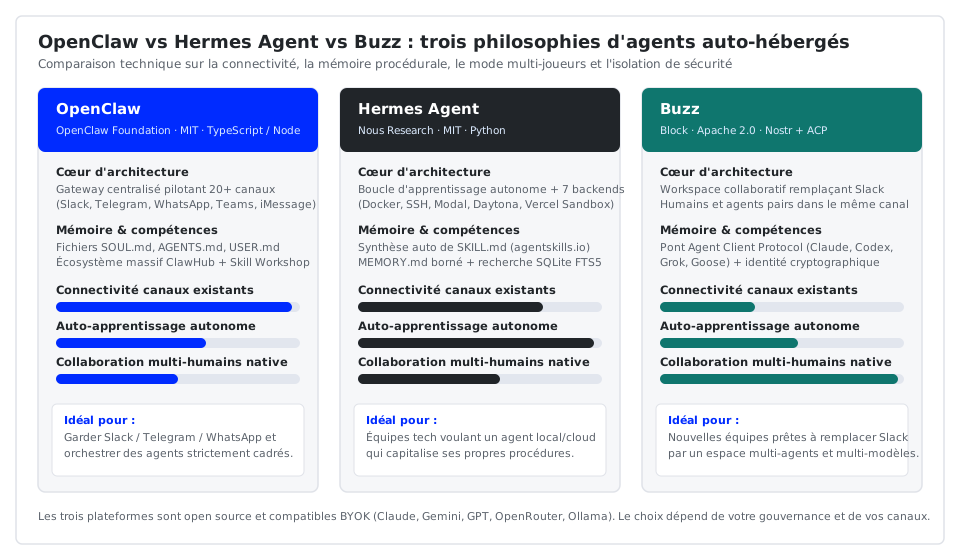
Side-by-side overview: three architectures built for three distinct workflows
| Technical dimension | OpenClaw | Hermes Agent | Buzz |
|---|---|---|---|
| Stewardship & license | OpenClaw Foundation · MIT | Nous Research · MIT | Block · Apache 2.0 |
| Primary stack | TypeScript / Node.js | Python | Nostr protocol + Agent Client Protocol (ACP) |
| Core design center | Multi-channel Gateway bridging existing chat apps | Self-improving learning loop & decoupled sandboxes | Multiplayer workspace built to replace Slack |
| Channels & UI | 20+ chat platforms (Slack, Telegram, WhatsApp, Teams, iMessage…) + Control UI | TUI, desktop app, Telegram, Slack, Discord, Signal, email | Dedicated persistent shared channels for humans and bots |
| Skills & memory | Declarative SKILL.md / SOUL.md + massive ClawHub registry | Autonomous SKILL.md synthesis (agentskills.io) + SQLite FTS5 | Multi-agent delegation via ACP (Claude, Codex, Grok, Goose) |
| Multiplayer collaboration | Single-operator remote control at heart (scoped shared sessions) | Profile-based + Bot Mode roster, primarily technical-user oriented | Native: multiple humans and multiple agents collaborate as peers |
| Execution & security | Tool allowlists + optional Docker/Podman sandboxing | 7 terminal backends (local, Docker, SSH, Modal, Daytona, Vercel) | Cryptographic keypair identity + revocable owner attestation |
1. OpenClaw: unmatched omnichannel reach and declarative control
Stewarded by the independent OpenClaw Foundation, OpenClaw revolves around a long-running Gateway control plane that manages sessions, device nodes, events, and more than twenty messaging integrations. Operators define each agent's role, boundaries, and tool permissions in clean, Git-versioned Markdown files (SOUL.md, AGENTS.md, TOOLS.md, USER.md).
- Key strengths: zero workspace migration is required — your agents meet employees directly inside the Slack, Telegram, WhatsApp, or Microsoft Teams channels they already use every day. Its community skill ecosystem (ClawHub) is the largest in the category, and a single Gateway can coordinate a whole roster of domain sub-agents under deterministic routing rules.
- Trade-offs and security caveats: OpenClaw evolved from a personal remote-control agent rather than a native multi-human chatroom (coordinating multi-agent replies inside shared team channels requires disciplined loop protection and relay rules). Because of its massive footprint, misconfigured public gateways are routinely scanned: never expose the Gateway port directly to the public internet, enforce container sandboxing, and lock administrative access behind a private mesh VPN such as Tailscale.
2. Hermes Agent: the Python harness that learns from its own experience
Built by Nous Research, Hermes Agent centers on a closed self-improving learning loop. After completing a non-trivial task — debugging a broken build, migrating data, or configuring a server — Hermes distills the working workflow into a portable SKILL.md file following the open agentskills.io specification, paired with bounded startup memory (MEMORY.md, USER.md) and full-text SQLite FTS5 session recall.
- Key strengths: Hermes genuinely gets faster and more reliable on recurring tasks over weeks of use without manual prompt re-engineering. Its standout systems feature is decoupled terminal execution: while chatting from Telegram or a local TUI, Hermes can execute commands inside local Docker, over remote SSH, or inside hibernating serverless sandboxes (Modal, Daytona, Vercel Sandbox). Migrating from an existing OpenClaw setup is even supported via
hermes claw migrate. - Trade-offs and security caveats: allowing an autonomous agent to write and modify its own procedural skills unrestricted in production carries silent drift risk — enterprise teams should always enable
skills.write_approval: trueso new skills require human sign-off. It also assumes a developer-comfortable operator rather than a non-technical business user.
3. Buzz: the open-source Slack replacement for native human + agent teams
Created at Block under the Apache 2.0 license, Buzz flips the integration model upside down: instead of bolting personal bots onto legacy chat apps, Buzz replaces the team workspace itself. Built on Nostr-backed channels and bridged via the Agent Client Protocol (ACP), Buzz lets four engineers and three specialized agents (Claude for architecture, Codex for code patches, Gemini for research) debate, hand off tasks, and review diffs side by side in the same persistent room.
- Key strengths: Buzz is the only platform of the three that is natively multiplayer, multi-agent, and multi-provider simultaneously. Every participant sees the full context in real time, and agent actions carry cryptographic identity and owner attestation, making Git or tool permissions explicitly traceable to — and instantly revocable by — an authorizing human.
- Trade-offs and security caveats: Buzz's biggest strength is also its steepest adoption hurdle: using Buzz means replacing Slack or adding yet another chat client. For organizations deeply standardized on Slack, Microsoft Teams, or Google Workspace, splitting conversations across two messaging platforms creates severe context fragmentation. Its third-party ERP and SaaS connector ecosystem is also younger than OpenClaw's or Hermes's.
Decision guide: which one should you choose?
- Choose OpenClaw if your company already lives in Slack, Telegram, or WhatsApp, wants strict, human-authored Markdown governance over a specialized agent roster, and values the deepest library of messaging and SaaS plugins — provided you harden the VPS perimeter properly (private VPN, strict tool allowlists, inbox isolation).
- Choose Hermes Agent if you are an engineer, data scientist, or R&D team looking for a local-first or cloud-sandboxed agent that compounds procedural memory (
SKILL.md) over time and isolates code execution cleanly across Docker or serverless sandboxes. - Choose Buzz if you are building a greenfield, AI-native product team willing to replace Slack outright so multiple humans and multi-vendor coding/research agents can collaborate as first-class peers in shared channels.
- Choose a governed enterprise data-and-agent platform (Google Cloud Agent Platform, Snowflake Cortex, or 21brain) whenever agents must query sensitive financial, ERP, or customer datasets under strict row-level RBAC and Swiss FADP / EU GDPR compliance without burdening your team with self-hosted agent maintenance.
Technical references
- OpenClaw — Official GitHub Repository & Gateway Documentation
- Nous Research — Hermes Agent GitHub & Technical Documentation
- Agent Skills Specification — Portable
SKILL.mdStandard - VDF AI — Hermes Agent vs OpenClaw: Architecture, Skills, Security and Fit (2026)
Need an independent architectural review to deploy, harden, or connect AI agents to your company's ERP and cloud data stack in Switzerland? Our AI engineering team designs secure, high-ROI multi-agent systems. Book a consultation or contact 21datas.
in Data