
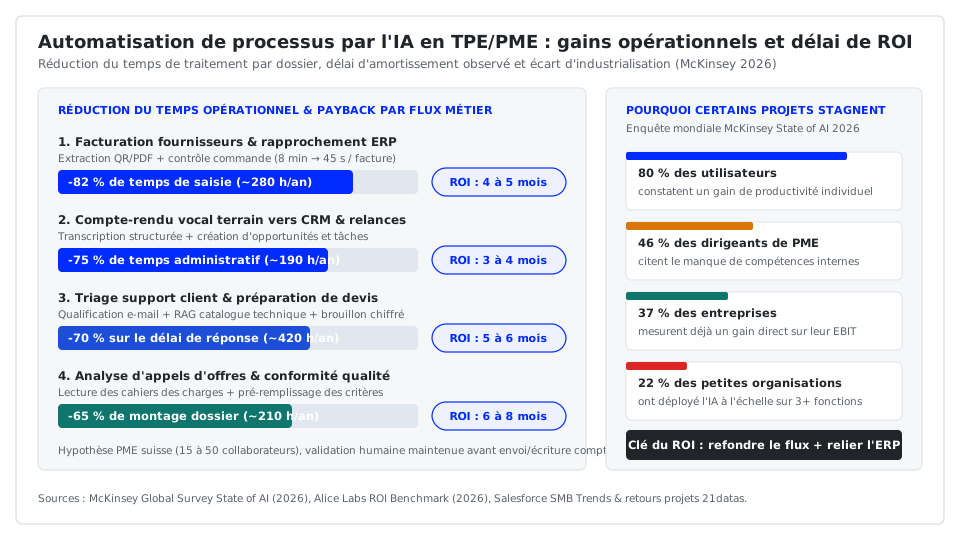
For small and medium-sized businesses (SMBs) of 5 to 100 employees, AI process automation is not about replacing teams with autonomous black boxes — it is about eliminating manual re-entry, slashing customer response times, and absorbing revenue growth without expanding administrative overhead. Yet a striking gap persists in the market: according to McKinsey's The State of AI 2026 global survey, while 80% of workers using AI report higher individual productivity, only 37% of companies measure a direct positive impact on EBIT, and just 22% of smaller organizations have scaled AI across three or more business functions.
Understanding why some initiatives stall as casual chat copy-pasting while others achieve full payback within four months requires an honest look at operational stakes, implementation obstacles, and rigorous return-on-investment (ROI) math.
What is truly at stake with AI automation for small and medium businesses
Unlike large corporations with dedicated back-office departments, SMBs rely on versatile key staff wearing multiple hats. A project manager drafts quotes late in the evening, an office manager manually keys supplier invoices into the accounting system while chasing overdue receivables, and sales reps spend a third of their week hunting through PDFs for technical specifications.
Traditional rule-based automation (legacy RPA or rigid webhook zaps) broke whenever a supplier changed an invoice layout or a customer phrased an order request in free-form natural language. Modern AI workflow automation pairs multimodal understanding with deterministic ERP rules, turning unstructured inputs (emails, PDFs, voice notes, tender documents) into clean, structured records ready for one-click validation.
The 4 main obstacles blocking SMBs — and how to overcome them
Cross-industry research from McKinsey, the OECD, and Salesforce SMB Trends highlights four consistent bottlenecks:
- Internal skills and bandwidth constraints (cited by 46% of SMB leaders): operational staff do not have time to babysit brittle prompts or maintain DIY scripts. Automation must live invisibly inside the tools employees already use every day (email, Slack, Odoo, Microsoft 365, or Google Workspace).
- Fragmented and inconsistent master data: connecting an AI agent to outdated price lists or duplicate customer records only accelerates mistakes. Cleansing product SKUs, pricing rules, and customer master data is an essential prerequisite.
- Skipping workflow redesign: summarizing an incoming email in a chat window saves thirty seconds; automatically extracting requested SKUs, checking live ERP inventory, and staging a complete draft quote saves fifteen minutes. Measurable EBIT impact comes from end-to-end process integration.
- Fear of autonomous errors and data privacy compliance (Swiss FADP / EU GDPR): in an SMB, an incorrect supplier payout or a mispriced quote hurts immediately. The architectural fix is mandatory human-in-the-loop validation: AI performs 95% of the extraction, matching, and drafting, while a human approves any binding financial or customer-facing action.
How to calculate AI automation ROI transparently
Every candidate workflow should be evaluated over a 12-month horizon using a straightforward financial formula:
Annual net gain = (Hours saved/year × Fully loaded hourly cost) + Avoided error/delay costs - (API + Maintenance costs)
Payback period (months) = Initial integration investment / (Annual net gain / 12)
In Switzerland and Western Europe, where fully loaded hourly costs for administrative, accounting, or technical sales roles typically range from CHF 65 to CHF 95/hour (EUR 50–85/hour), reclaiming just 5 hours per week on a recurring workflow frees 260 hours per year — worth CHF 16,900 to CHF 24,700 annually — while API token consumption on efficient models such as Gemini 4 Hydrogen typically stays between CHF 30 and CHF 120 per month at SMB volumes.
4 concrete, quantified SMB automation examples
| Business workflow & company profile | Before AI | Automated workflow with human-in-the-loop | Annual impact & payback |
|---|---|---|---|
| 1. Accounts payable & PO matching 25-person B2B services/trading firm (2,400 invoices/yr) | 8 min per invoice (reading PDF/QR bill, assigning GL account, checking PO) = 320 hrs/yr | Multimodal PDF extraction, automated purchase-order matching in Odoo, pre-filled accounting entry (45 s human review) | ~280 hrs/yr saved (~CHF 21,000 capacity) Payback: 4 to 5 months |
| 2. Customer support triage & quote drafting 40-person distributor / manufacturer (60 inquiries/day) | Manual catalog lookup and stock checks, 24–48 hr quote turnaround | Automated SKU extraction, hybrid RAG over technical datasheets + live ERP stock check, staged draft quote | ~420 hrs/yr saved + higher win rate from 15-min responses Payback: 5 to 6 months |
| 3. Field voice notes to structured CRM 8-person specialized contracting / sales team | Scattered evening notes, incomplete CRM pipeline, missed follow-ups | 90-second post-visit voice memo → transcription, budget/timeline extraction, updated CRM deal and scheduled follow-up task | ~190 hrs/yr saved (~4 hrs/wk across team) and +25% follow-up completion Payback: 3 to 4 months |
| 4. Public & private tender screening (SIMAP / RFPs) 15-person engineering / consulting firm | Reading hundreds of PDF pages manually to check eligibility and compliance matrices | Automated extraction of mandatory criteria, penalties, deadlines, and first-draft technical responses grounded in past winning bids | ~210 hrs/yr saved (-65% bid preparation time) Payback: 6 to 8 months |
A pragmatic 3-step roadmap for SMBs
Across our data consulting and AI engineering engagements, the highest-ROI deployments follow three disciplined steps:
- Audit 3 high-friction workflows with real baseline measurements: monthly volume, minutes per transaction, and rework rate.
- Ship one production-connected workflow in 3 to 5 weeks (typically ERP invoice/order processing or quote preparation) with human approval gates and live ROI telemetry.
- Reuse the same connectors and governed knowledge base (or a centralized workspace such as 21brain) to roll out subsequent automations at a fraction of the initial cost.
Sources and references
- McKinsey & Company — The State of AI: Global Survey 2026
- Alice Labs — AI Automation ROI Benchmark Report 2026
- OECD — SME Digitalisation and AI Adoption Reports
- Swiss Federal Data Protection and Information Commissioner (FDPIC) — FADP Compliance
Running an SMB in Switzerland or Europe and looking for a concrete ROI estimate on your own stack (Odoo, Microsoft 365, Google Workspace, or custom databases)? Book a discovery call with our engineers or get in touch.
in Data