
Every organization today accumulates growing volumes of information across ERP systems, CRM platforms, logistics tools, and web applications. Yet a wide gap remains between storing raw tables and making fast, reliable, profitable business decisions. Bridging that gap is the core mission of consulting data (data consulting) engagements.
Why do executives, CFOs, and CTOs turn to consulting data specialists rather than piecing tools together in-house? And why does a successful data initiative require six distinct professions rather than a single generalist hire? This guide explains the strategic ROI of consulting data and maps out every role in the modern data value chain.
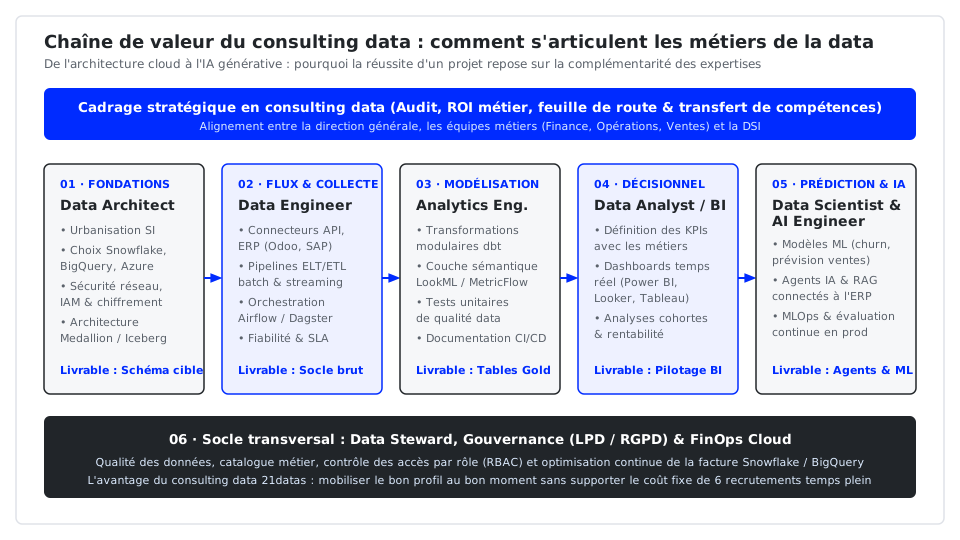
Consulting data: why bring in specialized external expertise?
Engaging a consulting data partner is not about outsourcing isolated SQL scripts. For SMEs and enterprises in Switzerland, a structured consulting data engagement solves four strategic challenges:
- Avoiding the "full-stack unicorn" hiring trap: Many companies attempt to hire one person expected to master cloud network security, Snowflake and BigQuery administration, Python ETL pipelines, financial modeling, Power BI design, and production AI agents. That single profile does not exist. Consulting data gives you access to a coordinated squad where each specialist contributes at the exact phase their skill is needed—at a fraction of the fixed cost of six full-time hires.
- Faster time-to-value with battle-tested blueprints: An experienced consulting data team brings proven ERP connectors (Odoo, SAP, Salesforce), automated testing frameworks, and modular architectures that deliver production results in weeks rather than eighteen months.
- Aligning business leadership and IT: Effective consulting data translates executive goals—improving gross margin, reducing working capital requirements, preventing stockouts—into governed, indisputable metrics.
- FinOps cloud cost control and regulatory compliance: Poorly partitioned queries or oversized warehouses can multiply cloud bills fivefold. Consulting data embeds FinOps optimization and Swiss FADP / GDPR compliance from day one.
Every profession in the data ecosystem explained: who does what in consulting data?
To understand why consulting data delivers durable value, let's examine how the six core data professions collaborate from raw data ingestion to predictive AI.
1. The Data Architect: designing scalable cloud foundations
At the start of a consulting data project, the Data Architect designs the target blueprint across Google Cloud BigQuery, Snowflake, Databricks, or Azure. They define the Medallion architecture (Bronze, Silver, Gold layers), open table formats (Apache Iceberg), IAM/RBAC security boundaries, and encryption standards.
2. The Data Engineer: building reliable ingestion and pipelines
Once the architecture is set, the Data Engineer builds automated pipelines that extract data from operational systems (ERP, accounting, e-commerce, APIs) and load it reliably into the warehouse using Python, SQL, Spark, Airflow, or Dagster.
3. The Analytics Engineer: governing business logic and the Semantic Layer
A pivotal role in modern consulting data, the Analytics Engineer bridges raw engineering and business analytics. Using dbt and semantic layers such as LookML (Looker) or MetricFlow, they transform raw tables into tested, documented business models so metrics like "Net Revenue" or "Customer Retention" have a single canonical definition across the company.
4. The Data Analyst & BI Developer: turning metrics into decisions
Working closely with finance, sales, and operations, the Data Analyst and Dashboarding / BI specialist build real-time interactive dashboards in Power BI, Looker, or Tableau, performing cohort, pricing, and profitability analyses.
5. The Data Scientist & AI Engineer: predictive modeling and autonomous agents
When the data foundation is trustworthy, consulting data unlocks high-ROI Data Science and AI Engineering. Data Scientists build forecasting, churn, and anomaly-detection models, while AI Engineers deploy governed RAG systems and autonomous agents connected to your ERP and warehouse (such as 21brain).
6. The Data Steward & Governance / FinOps Lead: ensuring trust and cost efficiency
Finally, sustainable consulting data relies on strong data governance: cataloging assets, enforcing row-level security, ensuring Swiss FADP / GDPR compliance, and monitoring cloud FinOps spend.
| Data role | Core question answered | Reference consulting data stack |
|---|---|---|
| Data Architect | How do we structure and secure the cloud platform? | Snowflake, BigQuery, Azure, Apache Iceberg, Terraform |
| Data Engineer | How do we ingest and orchestrate reliable data flows? | Python, SQL, Airflow, Dagster, REST / JSON-2 APIs |
| Analytics Engineer | How do we standardize and test business definitions? | dbt, LookML, MetricFlow, Git CI/CD |
| Data Analyst / BI | How do we monitor business performance in real time? | Power BI, Looker, Tableau, analytical SQL |
| Data Scientist / AI Engineer | How do we predict outcomes and automate workflows with AI? | Python, Scikit-Learn, Snowflake Cortex, Vertex AI, 21brain |
| Data Steward / FinOps | How do we guarantee compliance and cloud ROI? | Data Catalog, Row-Level Security, FinOps monitoring |
Why partner with 21datas for your consulting data initiatives in Switzerland?
Based in Belmont-sur-Lausanne, 21datas brings together Data Engineers, Data Analysts, Data Scientists, and AI Engineers in a tight-knit technical team. Our consulting data methodology focuses on rapid production delivery, full code and documentation ownership for your teams, and measurable business ROI.
Explore all our services, book a free initial evaluation, or contact us directly to discuss your roadmap.
in Data