
With hundreds of proprietary and open-weight large language models (LLMs) competing on the market, choosing the right model for an enterprise workload can no longer rely on vendor release blog posts. Every model launch features cherry-picked charts claiming state-of-the-art performance.
To objectively evaluate reasoning accuracy, coding reliability, inference latency, and real production cost, AI engineering teams cross-reference seven independent benchmark platforms. Here is the definitive guide to the best AI model comparison websites in 2026.
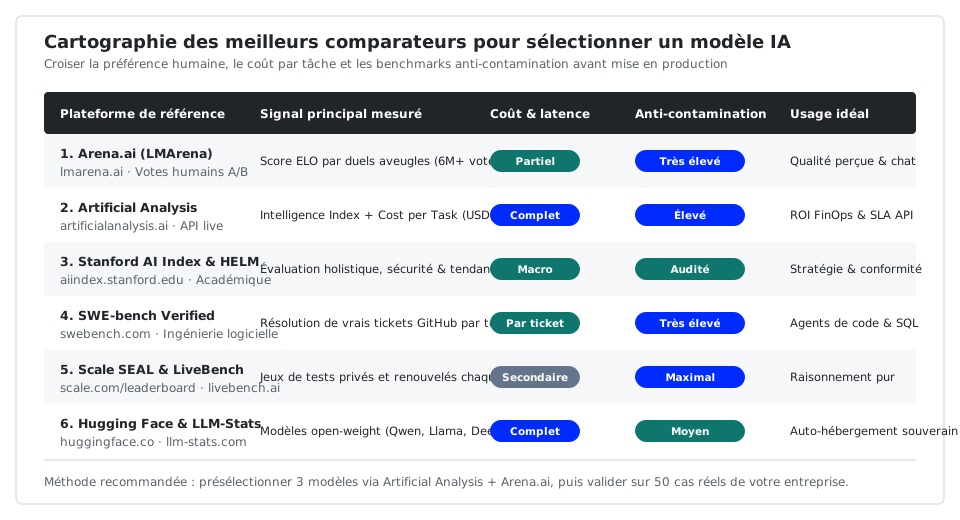
1. Arena.ai / LMArena (LMSYS Chatbot Arena): the gold standard for blind human preference
Founded by researchers at UC Berkeley (LMSYS), Arena.ai (LMArena) is the world's largest crowdsourced evaluation platform, backed by over six million blind pairwise human votes. Users submit a real-world prompt, two anonymous models generate side-by-side responses, and the user votes for the better answer before model identities are revealed.
- What it measures best: Bradley-Terry ELO scores reflecting real human preference across specialized categories including Coding, Hard Prompts, Math, Vision, WebDev, and multilingual tasks.
- Critical tip: Always enable the Style Control toggle on Arena.ai to strip out verbosity and markdown formatting biases so you measure substance rather than length.
2. Artificial Analysis: the benchmark for cost per task, speed, and API providers
While Arena.ai captures human preference, Artificial Analysis continuously benchmarks live API endpoints for intelligence, latency, and unit economics.
- What it measures best: The composite Intelligence Index, Cost per Task (the actual dollar cost to complete the full benchmark suite, factoring in reasoning tokens and verbosity), output throughput (tokens/second), and time to first token (
TTFT). - Why it is indispensable: For open-weight models (such as DeepSeek, Qwen, or Llama), Artificial Analysis also compares inference hosts (Vertex AI, AWS Bedrock, Snowflake Cortex, Together, Fireworks, Groq) side by side.
3. Stanford Artificial Intelligence Index (HAI) & HELM: scientific rigor and governance
Published by the Human-Centered AI Institute (HAI) at Stanford University, the Artificial Intelligence Index and its technical evaluation suite HELM (Holistic Evaluation of Language Models) provide peer-reviewed, multidimensional analysis.
- What it measures best: Calibration, robustness, fairness, safety, environmental footprint, and long-term inference cost trends.
- When to use it: For multi-year AI roadmaps, executive briefings, and data governance and compliance assessments.
4. SWE-bench (Verified & Multimodal): real-world software engineering and agentic coding
Synthetic single-function coding benchmarks like HumanEval are now saturated above 95%. Created by Princeton researchers, SWE-bench tests whether an LLM and agent scaffold can resolve real GitHub issues across complex open-source repositories.
- What it measures best: Multi-file code navigation, bug reproduction, patch generation, and passing real unit test suites (
SWE-bench Verified). - Why it matters: If you are picking a model for data engineering, dbt/SQL pipeline generation, or tool-calling agents, SWE-bench Verified is one of the strongest predictors of production reliability.
5. Scale SEAL Leaderboards and LiveBench: defeating benchmark contamination
A major threat to public benchmarks is training data contamination: once test questions appear on the public web, future models inadvertently memorize them during pretraining.
- Scale SEAL Leaderboards: Uses private, expert-authored evaluation sets across coding, finance, law, and complex instruction following that are never released publicly.
- LiveBench: Continuously refreshes questions from recent math competitions, ArXiv papers, and news datasets with deterministic ground-truth scoring rather than biased LLM-as-a-judge grading.
6. Hugging Face Open LLM Leaderboard & LLM-Stats: open-weight and aggregator tools
- Open LLM Leaderboard (Hugging Face): Tracks open-weight models and quantization trade-offs (FP16, FP8, INT4).
- Aggregator portals (LLM-Stats, BenchLM, Vellum): Let teams filter 300+ models by context window, license, API pricing, and cross-benchmark scores.
A 4-step methodology for choosing the right model
At 21datas, we advise clients never to rely on a single leaderboard:
- Filter by operational SLA and Cost per Task on Artificial Analysis.
- Shortlist 3–4 contamination-tested leaders on LiveBench, Scale SEAL, and SWE-bench.
- Check human readability and multilingual fluency on Arena.ai (with Style Control enabled).
- Run a 50-prompt internal evaluation on your own enterprise data before rolling out to production in 21brain.
Need help benchmarking and integrating the right AI models into your stack? Book a consultation or contact our team.
in Data