
Deploying an enterprise AI assistant capable of querying governed financial tables, searching PDF contracts, and running predictive models without moving data outside your cloud data platform is a top priority for modern data teams. With Snowflake Cortex — combining Cortex Analyst, Cortex Search, and the Cortex Agents orchestration API — engineering teams can build production agents governed directly by Snowflake RBAC.
However, production deployments consistently reveal a critical architectural lesson: attaching dozens of tables and tools to a single monolithic agent causes accuracy to plummet. The proven solution is a domain-scoped multi-agent architecture coordinated by a central router agent.
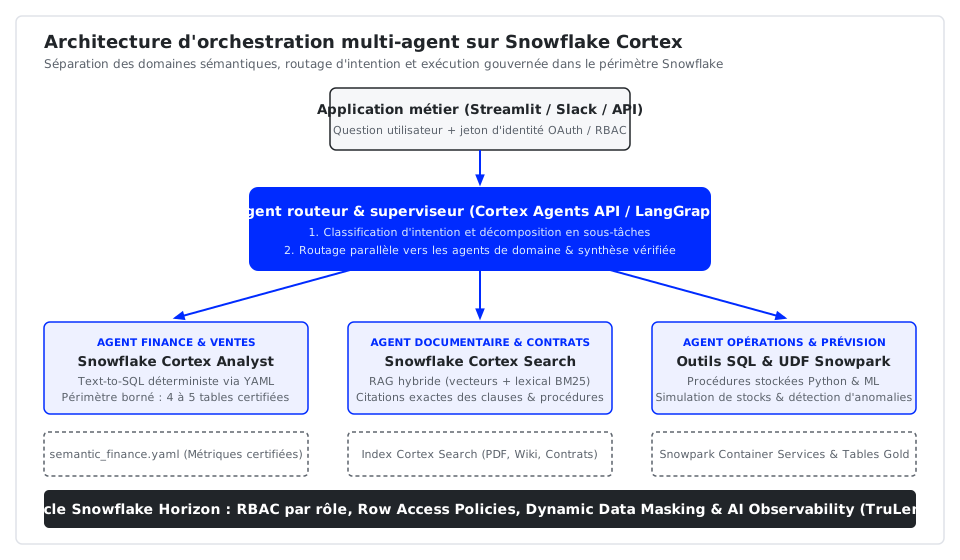
Step 1: configuring specialized domain agents in Snowflake Cortex
A production-grade agentic stack on Snowflake combines three specialized building blocks, each scoped to a bounded business domain:
1. Cortex Analyst for structured data (deterministic Text-to-SQL)
Rather than exposing raw database DDL across hundreds of tables, Snowflake Cortex Analyst relies on a declarative YAML semantic model stored in a Snowflake stage (@analytics_db.governance.semantic_models/finance_model.yaml). The YAML specification defines verified dimensions, business synonyms, valid join paths, and canonical metric formulas (such as ARR, gross margin, or DSO).
Production architecture studies from CloudEQS on scaling Cortex Analyst and phData highlight a crucial golden rule: cap each semantic view at 4 to 5 tightly related tables. Exceeding this threshold introduces column ambiguity and degrades join accuracy.
2. Cortex Search for unstructured documents (hybrid RAG)
For unstructured repositories (supplier contracts, quality manuals, support tickets), Cortex Search combines dense vector similarity with lexical keyword matching (BM25) and semantic reranking directly in SQL:
CREATE OR REPLACE CORTEX SEARCH SERVICE legal_db.contracts.contract_search_svc
  ON chunk_text
  ATTRIBUTES contract_id, supplier_name, jurisdiction, expiration_date
  WAREHOUSE = cortex_wh
  TARGET_LAG = '1 hour'
  AS (
    SELECT chunk_text, contract_id, supplier_name, jurisdiction, expiration_date
    FROM legal_db.contracts.parsed_contract_chunks
  );
3. Custom tools via Snowpark Python UDFs and stored procedures
For operational actions and forecasting models (inventory reorder simulations, anomaly scoring), each capability is wrapped as a strongly typed SQL stored procedure or Snowpark Python UDF.
Step 2: building the application with a router agent orchestrating all sub-agents
Instead of forcing business users to pick between separate bots, the application exposes a unified interface backed by a router agent (supervisor). Using the Snowflake Cortex Agents API, the Snowflake Labs Orchestration Framework, or a LangGraph supervisor graph on Snowflake, the router performs four steps:
- Intent classification and query decomposition: When a CFO asks "Why did our net margin drop in Q3 in Western Switzerland, and what price-revision clauses exist in our logistics contracts?", the router splits the prompt into two domain sub-tasks.
- Parallel sub-agent dispatch: The financial sub-task is routed to the
Finance Agent(bound tofinance_model.yamlvia Cortex Analyst), while the contractual sub-task is dispatched in parallel to theLegal Agent(bound tocontract_search_svcvia Cortex Search). - Governed execution under user RBAC: Each specialist runs under the caller's Snowflake role, enforcing Row Access Policies and Dynamic Data Masking.
- Verified synthesis: The router merges the deterministic SQL results with cited contract clauses and streams the answer back to the user interface (Streamlit in Snowflake, Slack, or a custom application such as 21brain).
Why a multi-agent architecture outperforms a single monolithic agent
A common pitfall is stuffing 25 SQL tables and 15 tools into a single "omni-agent" prompt. Both academic research and enterprise benchmarks confirm that specialized multi-agent systems consistently outperform monolithic single agents as domain complexity grows.
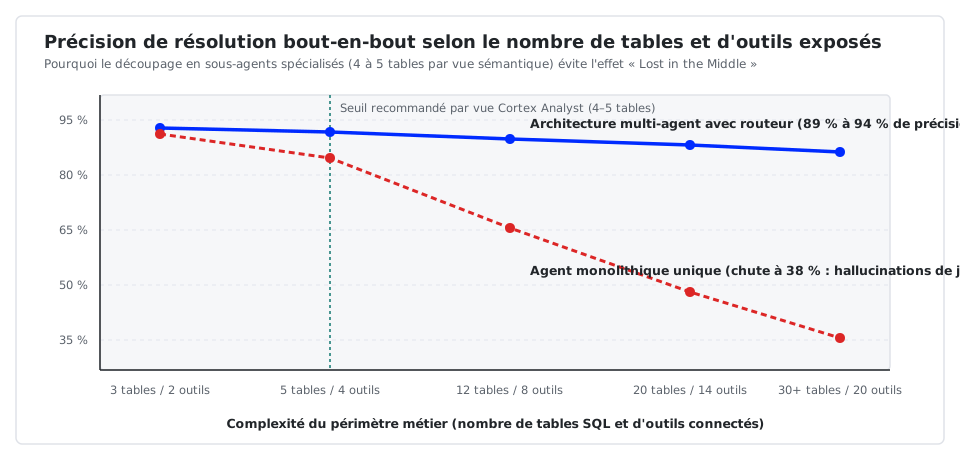
Four documented mechanisms explain why multi-agent routing wins:
- Eliminating the "Lost in the Middle" effect: Landmark research from Stanford University and UC Berkeley (Liu et al., Lost in the Middle: How Language Models Use Long Contexts, TACL) proves that LLM retrieval and reasoning accuracy degrades sharply when relevant schema details are buried inside a massive context window. Keeping each specialist agent scoped to 4–5 tables preserves high attention density.
- Preventing tool-selection confusion: Architectural evaluations from phData and Snowflake's LangGraph guides show that once an agent has more than 6–8 overlapping tools, parameter hallucination rises steeply. A hub-and-spoke router keeps end-to-end accuracy above 89%.
- Lower token cost and parallel latency: Because the router only loads the financial YAML schema when finance is involved, input token consumption drops by 60–75% while parallel sub-agents reduce wall-clock latency.
- Least-privilege RBAC isolation and observability: Each specialist agent only accesses its authorized domain and logs granular traces (measurable via Snowflake AI Observability / TruLens) for compliance auditing.
Technical references and sources
- Snowflake Documentation — Cortex Agents & Orchestration API
- Snowflake Documentation — Cortex Analyst Semantic Model Specification
- Snowflake Labs — Multi-Agent Orchestration Framework (GitHub)
- Snowflake Developers Guide — Build and Evaluate Multi-Agent Systems with Snowflake and LangGraph
- phData — Snowflake Cortex Agents: Governed Multi-Agent Architecture Guide
- CloudEQS — How to Scale AI Agents with Snowflake Cortex Analyst
- Liu et al. (Stanford / UC Berkeley) — Lost in the Middle: How Language Models Use Long Contexts
As a specialist in Snowflake data engineering and AI engineering in Switzerland, 21datas designs governed Cortex semantic layers and multi-agent routers. Contact us or book a technical consultation to architect your deployment.
in Data