
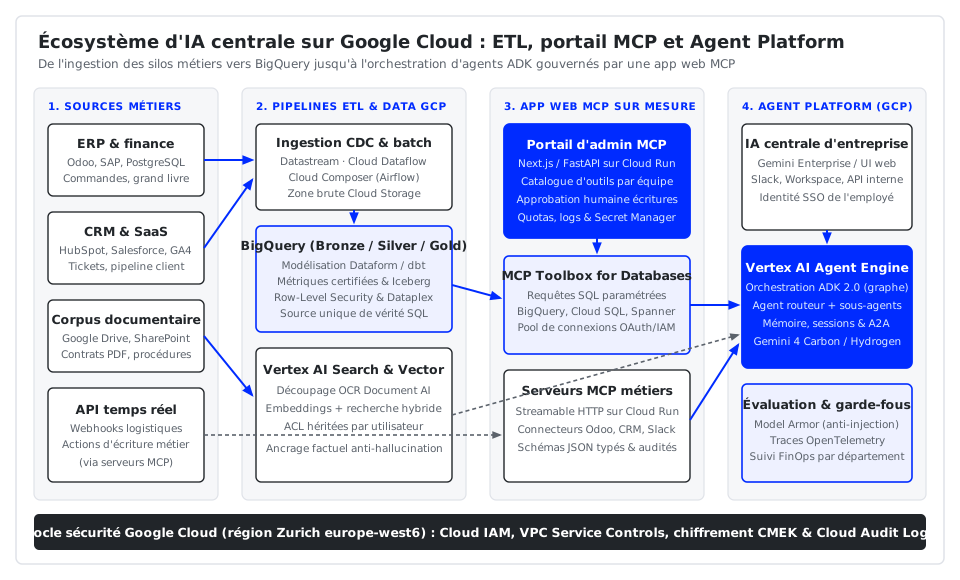
Spinning up isolated chatbots wired directly to ad-hoc spreadsheets or raw SaaS endpoints rarely delivers reliable enterprise intelligence. As soon as finance, operations, logistics, and sales teams query unharmonized sources, agents return conflicting metrics and create serious permission blind spots. Building a governed central enterprise AI on Google Cloud (GCP) rests on three tightly integrated pillars: a unified data ecosystem fed by ETL/ELT pipelines into BigQuery, domain-scoped agents orchestrated in Google Cloud Agent Platform (Vertex AI Agent Builder / Gemini Enterprise), and a custom internal web application acting as your MCP control plane (Model Context Protocol).
1. Unifying your data ecosystem with ETL and ELT pipelines into GCP
An AI agent is only as trustworthy as the semantic layer underneath it. Before writing a single agent prompt in Vertex AI, engineering teams must eliminate operational data silos by streaming and modeling core business entities inside Google Cloud.
Real-time CDC and batch ingestion into Cloud Storage and BigQuery
In a modern data engineering stack, ingestion patterns are matched to source criticality and latency requirements:
- Operational databases (PostgreSQL, MySQL, Oracle, SQL Server, AlloyDB): Google Cloud Datastream captures transaction logs continuously via agentless Change Data Capture (CDC) and replicates changes into BigQuery or Cloud Storage within minutes.
- ERPs, CRMs, and business SaaS APIs (Odoo, SAP, HubSpot, Salesforce, HRIS): incremental extractors orchestrated by Cloud Composer (managed Apache Airflow) or serverless Cloud Run Jobs land immutable raw payloads in Cloud Storage (Bronze zone) before loading typed staging tables.
- Event streams and telemetry: Pub/Sub paired with Cloud Dataflow (Apache Beam) validates, deduplicates, and enriches streaming events on the fly.
- Unstructured enterprise knowledge (PDF contracts, RFPs, SOPs, tickets): documents stored in Cloud Storage are parsed by Document AI (preserving complex tables and headings) and indexed into Vertex AI Search, combining dense vector embeddings, keyword search, and strict user-level ACL inheritance.
Medallion modeling and fine-grained governance in BigQuery
Inside BigQuery, Dataform or dbt transforms raw Bronze feeds into cleansed, deduplicated Silver entities and certified Gold marts exposing canonical definitions for net revenue, gross margin, inventory coverage, and customer receivables. Governance is enforced directly at the storage and query layer via Dataplex: Row-Level Security (filtering rows by subsidiary or region), Policy Tags (dynamic column masking for payroll or personal data under the Swiss FADP and EU GDPR), and regional data residency in europe-west6 (Zurich).
2. Developing and scaling agents in Google Cloud Agent Platform
Within Google Cloud's Gemini Enterprise Agent Platform (encompassing Vertex AI Agent Builder), teams combine code-first software engineering rigor with a fully managed runtime.
Designing deterministic multi-agent graphs with ADK 2.0
Google's open-source Agent Development Kit (ADK 2.0) (available for Python, TypeScript, Go, and Java) lets developers replace fragile mega-prompts with a deterministic graph workflow. A central router agent classifies user intent and delegates execution to domain specialists (finance, supply chain, legal compliance, CRM) using graph transitions or the A2A (Agent-to-Agent) protocol. Complex architectural planning can run on Gemini 4 Carbon, while high-speed tool execution runs on Gemini 4 Hydrogen.
Managed production runtime on Vertex AI Agent Engine
With a single CLI command, ADK graphs deploy onto Vertex AI Agent Engine, providing out-of-the-box infrastructure for:
- Stateful session management and persistent memory scoped per authenticated employee.
- Prompt-injection and data-exfiltration defense through Model Armor, inspecting both user prompts and external tool outputs.
- End-to-end OpenTelemetry traces exported to Cloud Trace and Cloud Logging to monitor tool latency, reasoning trajectories, and department-level token FinOps.
3. Managing MCP servers from a custom internal web app
As soon as an enterprise connects agents to ten or more internal systems (BigQuery, Odoo, Jira, Google Workspace, Slack, warehouse APIs), hardcoding tool definitions and credentials inside each agent repository becomes a maintenance and security liability. While the Model Context Protocol (MCP) standardizes how agents discover and invoke tools, enterprise production requires building a lightweight, custom web control plane to govern those MCP servers.
Blueprint for a homemade MCP governance portal on Cloud Run
Deploying an internal admin web app (for example Next.js or FastAPI protected by Identity-Aware Proxy — IAP on Cloud Run, backed by Cloud SQL PostgreSQL and Secret Manager) gives IT and data teams centralized control over four critical capabilities:
- Unified MCP server registry: manage private Streamable HTTP MCP endpoints hosted on Cloud Run — including Google's official MCP Toolbox for Databases (exposing parameterized, pre-vetted SQL queries against BigQuery, Cloud SQL, or Spanner instead of letting an LLM execute arbitrary SQL) alongside custom business MCP servers (Odoo JSON-2 API, CRM, ticketing).
- Role-based tool filtering (RBAC): finance analysts automatically receive
bigquery.finance_kpistools, whereas sales managers receive CRM and quoting tools without seeing HR or payroll endpoints. - Human-in-the-loop approval for write operations: any MCP tool flagged
write_action = truein the web portal pauses execution and sends a structured confirmation card to the user before mutating ERP or database records. - Instant kill switches, rate limits, and audit logs: disable a misbehaving connector or rotate credentials in Secret Manager from the web UI without redeploying a single Vertex AI agent.
# Dynamically loading RBAC-filtered MCP servers from your custom web portal into a Google ADK agent
import httpx
from google.adk.agents import LlmAgent
from google.adk.tools.mcp_tool import MCPToolset, StreamableHTTPConnectionParams

async def build_enterprise_agent(user_email: str, id_token: str) -> LlmAgent:
    # 1. Fetch authorized MCP endpoints and tool allowlists from the internal MCP web control plane
    async with httpx.AsyncClient(timeout=10.0) as client:
        resp = await client.get(
            "https://mcp-admin.internal.company.ch/api/v1/authorized-servers",
            params={"user": user_email},
            headers={"Authorization": f"Bearer {id_token}"},
        )
        resp.raise_for_status()
        mcp_configs = resp.json()["servers"]

    # 2. Attach only the user-authorized Streamable HTTP MCP toolsets
    toolsets = [
        MCPToolset(
            connection_params=StreamableHTTPConnectionParams(
                url=srv["endpoint_url"],
                headers={"Authorization": f"Bearer {srv['scoped_obo_token']}"},
            ),
            tool_filter=srv["allowed_tool_names"],
        )
        for srv in mcp_configs
    ]

    return LlmAgent(
        name="central_enterprise_assistant",
        model="gemini-4-hydrogen",
        instruction=(
            "You are the central enterprise AI assistant. Ground every metric in certified "
            "BigQuery MCP tools and cite Vertex AI Search documents."
        ),
        tools=toolsets,
    )
Why combining GCP ETL, a custom MCP portal, and Agent Platform wins
By cleanly decoupling your governed data foundation (ETL into BigQuery + Vertex AI Search), your tool governance layer (the custom MCP admin web app), and your agent runtime (ADK 2.0 on Vertex AI Agent Engine), your company avoids vendor lock-in while maintaining strict security compliance. You can swap Gemini models in minutes, onboard new ERP or SaaS MCP tools from a single web dashboard, and expose one trusted enterprise brain across Google Workspace, Slack, or a bespoke interface like 21brain.
Technical references
- Google Cloud Documentation — Vertex AI Agent Builder & Agent Engine
- Google Agent Development Kit (ADK) — Official Documentation
- Google Cloud — MCP Toolbox for Databases (GitHub)
- Model Context Protocol (MCP) — Streamable HTTP & Authorization Specification
- Google Cloud Architecture Center — Datastream & BigQuery Lakehouse Patterns
As a Swiss Google Cloud Select Technology Partner, 21datas architects and delivers end-to-end BigQuery ETL pipelines, custom MCP control planes, and governed multi-agent platforms across Google Cloud and AI engineering. Book a technical consultation or contact our team to scope your central enterprise AI.
in Data