
Selecting a large language model (LLM) for enterprise production based solely on the headline price per million tokens is one of the most expensive mistakes engineering teams make in 2026. Between reasoning models that silently generate ten times more internal thinking tokens, budget models that fail on the first tool call and require three retry loops, and frontier models that leverage prompt caching, the gap between list token price and actual monthly API spend routinely exceeds 300%.
To identify which AI models truly deliver the best value for money, data engineering and FinOps teams now rely on a decisive metric: cost per task, standardized by Artificial Analysis and cross-referenced with blind human preference ELO ratings from Arena.ai (LMArena) as well as macroeconomic trends tracked by the Stanford AI Index.
Why price per million tokens is misleading for enterprise AI budgets
Historically, technical leaders compared LLM APIs using a simple two-column spreadsheet: input price per million tokens and output price per million tokens. That approach worked when models produced single-turn completions of comparable length. With reasoning models and multi-step agentic workflows, raw token pricing hides four critical cost multipliers:
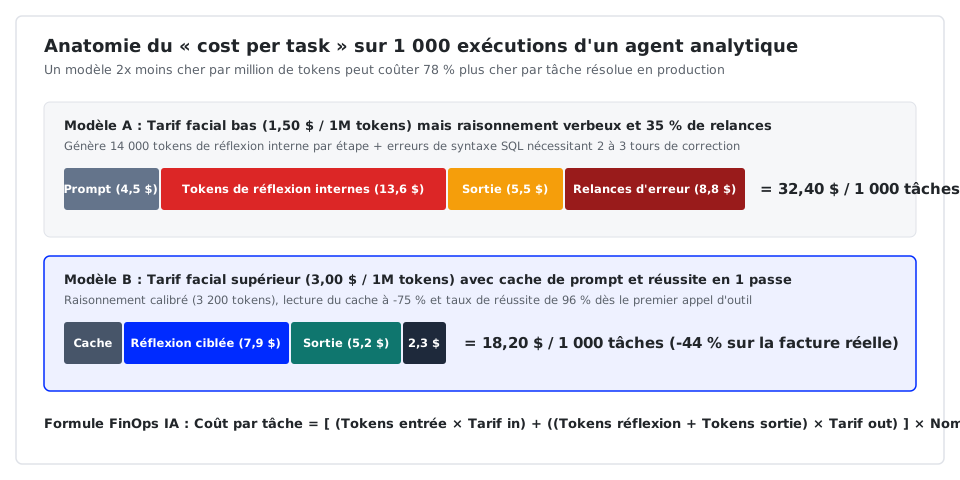
- Internal reasoning token inflation: When a reasoning model decomposes a problem before answering, all chain-of-thought tokens are billed at the output token rate (typically four to five times higher than the input rate). A model priced at $1.50 per million output tokens that generates 14,000 internal thinking tokens costs significantly more per query than a $4.00 model that solves the same problem in 2,500 tokens.
- First-pass success rate in tool calling: When an AI agent queries a Snowflake or BigQuery warehouse or an ERP API, a malformed JSON payload or invalid SQL join triggers a retry loop. Each retry resends the full system prompt, schema context, and error trace.
- Prompt caching efficiency: Modern providers discount cached prompt prefixes by 50% to 90%. Effective task cost depends heavily on cache hit rates and how cleanly an architecture separates static system instructions from dynamic user context.
- Output verbosity and latency: Overly verbose models inflate output token billing while increasing end-to-end response times for business users.
How Artificial Analysis measures real cost per task
Cost per task measures the total dollar amount required to complete a standardized suite of complex evaluations (code generation, mathematical and financial reasoning, document synthesis, and structured tool invocation). In the Artificial Analysis methodology, every model runs the full benchmark suite behind the Intelligence Index (including MMLU-Pro, GPQA Diamond, LiveCodeBench, SciCode, and instruction-following benchmarks).
By multiplying the exact input tokens, internal reasoning tokens, and visible output tokens consumed across the entire evaluation by the provider's live API rates, cost per task captures the true economic equation of an AI deployment:
Cost per task = [ (Input tokens × Price_in) + ((Reasoning tokens + Output tokens) × Price_out) ] × (1 / First-pass success rate)
2026 model comparison: cost per task vs Arena.ai ELO and Intelligence Index
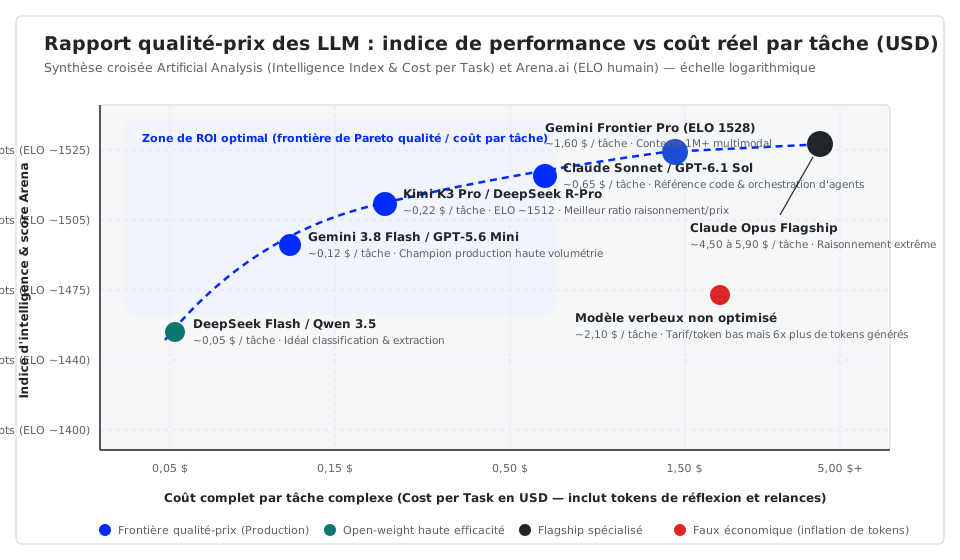
Combining the Artificial Analysis Intelligence Index and Cost per Task metrics with blind pairwise human preference ratings from Arena.ai reveals four distinct tiers along the Pareto value frontier:
| Model family | Category | Arena.ai ELO (approx.) | Intelligence Index | Average benchmark task cost | Highest-ROI enterprise use case |
|---|---|---|---|---|---|
| Gemini 3.8 Flash / Flash-Lite | Fast proprietary | ~1485 – 1500 | 48 – 52 | $0.08 – $0.15 | Agent routing, high-volume RAG, structured extraction |
| DeepSeek R-Pro / Kimi K3 | Open-weight reasoning | ~1505 – 1515 | 53 – 56 | $0.18 – $0.35 | Analytical reasoning, high-volume SQL and Python generation |
| Qwen 3.5 / DeepSeek Flash | Ultra-low-cost open-weight | ~1450 – 1480 | 42 – 46 | $0.03 – $0.08 | Classification, ticket triage, tagging, pre-filtering |
| Claude Sonnet / GPT-6.1 Sol | Balanced frontier | ~1515 – 1522 | 55 – 58 | $0.55 – $0.95 | Complex multi-agent orchestration, software engineering |
| Gemini Frontier Pro (High) | Multimodal frontier | ~1525 – 1530 | 58 – 60 | $1.40 – $2.10 | Long-context (1M+ tokens) corpus analysis and multimodal audit |
| Claude Opus Flagship | Maximum capability | ~1515 – 1525 | 59 – 61 | $4.20 – $5.98 | High-stakes architecture, legal review, complex debugging |
1. High-volume production champions: Flash and Mini tiers
For roughly 80% of enterprise workflows, models in the Gemini Flash and GPT Mini class sit at the sweet spot of the Pareto curve. They deliver strong instruction following and reliable tool calling at a fraction of a cent per interaction while sustaining throughput above 150 tokens per second.
2. Open-weight reasoning challengers: Kimi, DeepSeek, and Qwen
As documented in the Stanford AI Index Report, open-weight models have closed the capability gap with proprietary models while reducing inference costs by 60% to 85%. Models such as Kimi K3, DeepSeek, and Qwen 3.5 achieve top-tier reasoning scores at a cost per task below $0.35, making them ideal for data-intensive pipelines and sovereign deployments.
3. Balanced and flagship frontier models: when higher token prices save money
On complex coding benchmarks like SWE-bench or multi-step agentic orchestration, balanced frontier models (Claude Sonnet, GPT-6.1 Sol) often achieve a lower total cost per resolved workflow than cheaper models because they succeed on the first tool invocation without retry loops.
The recommended FinOps architecture: tiered model routing
No single model offers the best price-performance ratio across every prompt. Running a flagship model on 100% of traffic wastes up to 80% of your AI budget, while forcing a small model onto complex analytical queries erodes business trust.
At 21datas, our AI Engineering deployments and 21brain platform use a two-tier semantic router: a fast, low-cost router handles intent classification and routine retrieval, escalating to a frontier reasoning model only when cross-domain SQL synthesis or complex planning is required. Book a meeting with our team or contact us to benchmark cost per task on your own workloads.
in Data